Goamogh — Monday Decision Brief
Marketing, advertising, marketplace listings, export and AI — with a clear recommendation, and live-captured evidence for the blocker.
Visual evidence: the blocker
Everything below was captured live from goamogh.com on 3 October 2026
using headless Chrome 138 over the DevTools Protocol. Nothing here is illustrative.
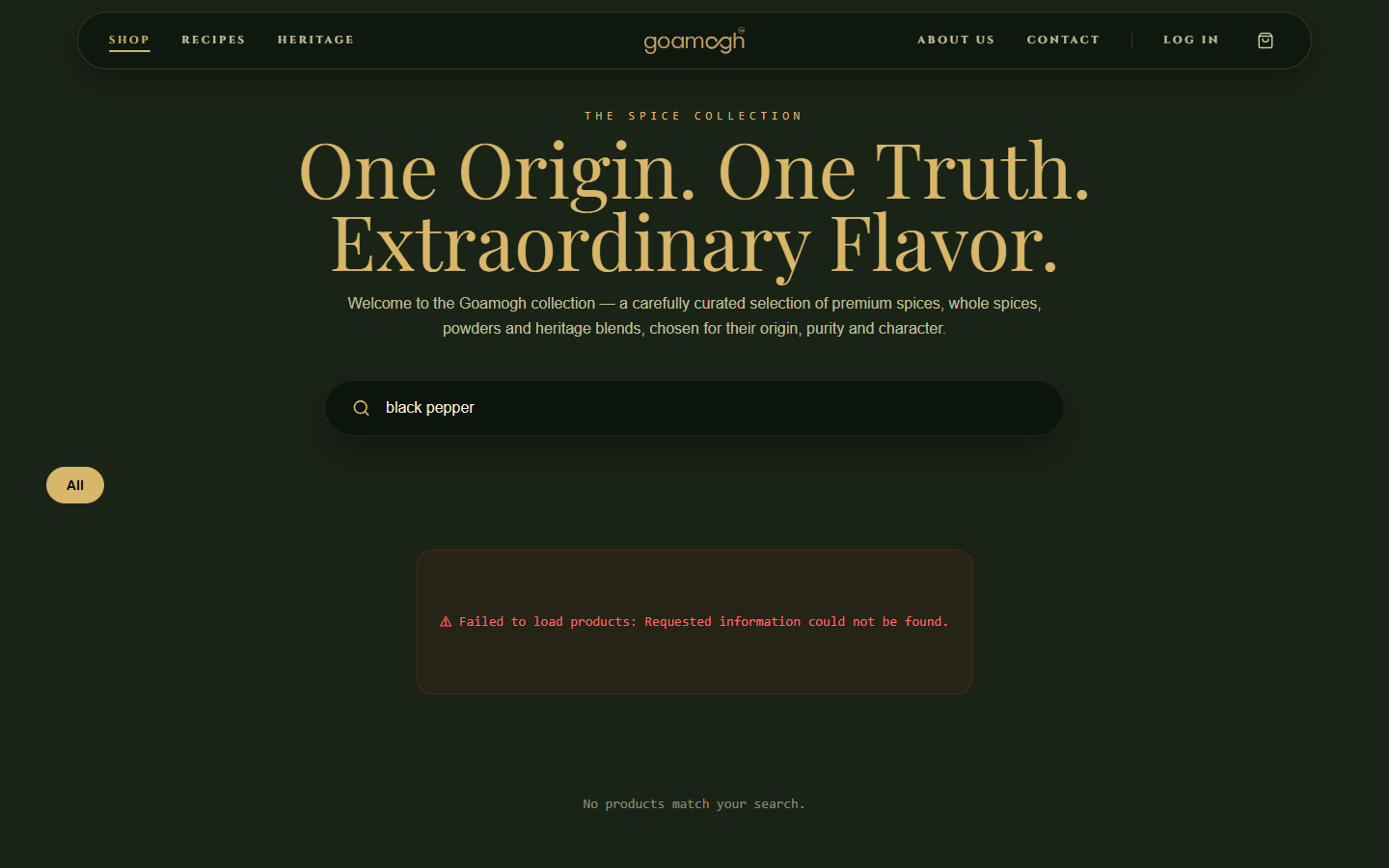
Not "has checkout friction." It cannot take an order. Two environment
variables — NEXT_PUBLIC_API_URL and NEXT_PUBLIC_RAZORPAY_KEY_ID — were
never inlined at build time, so the API base resolves to the literal string
undefined/api/v1.
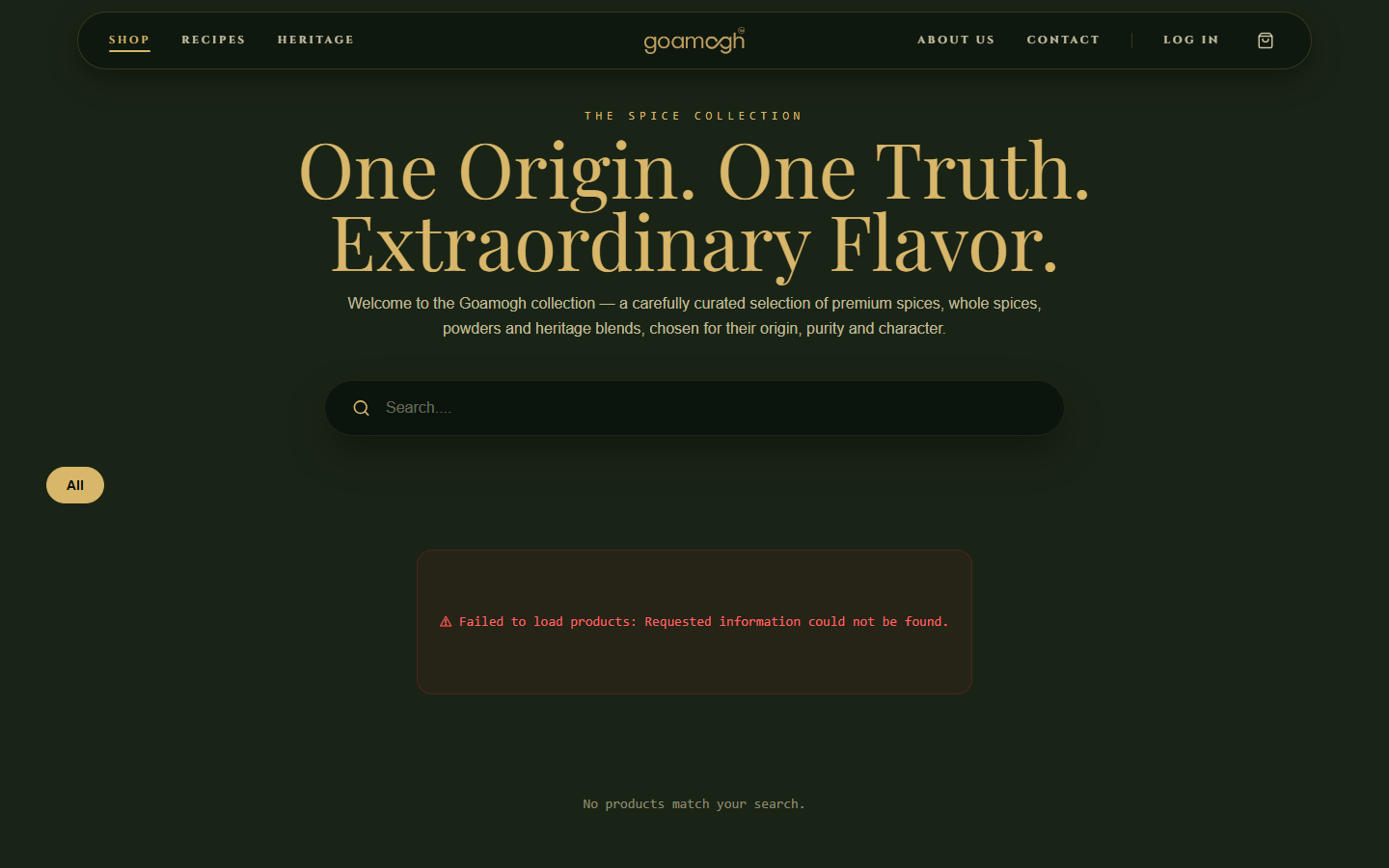
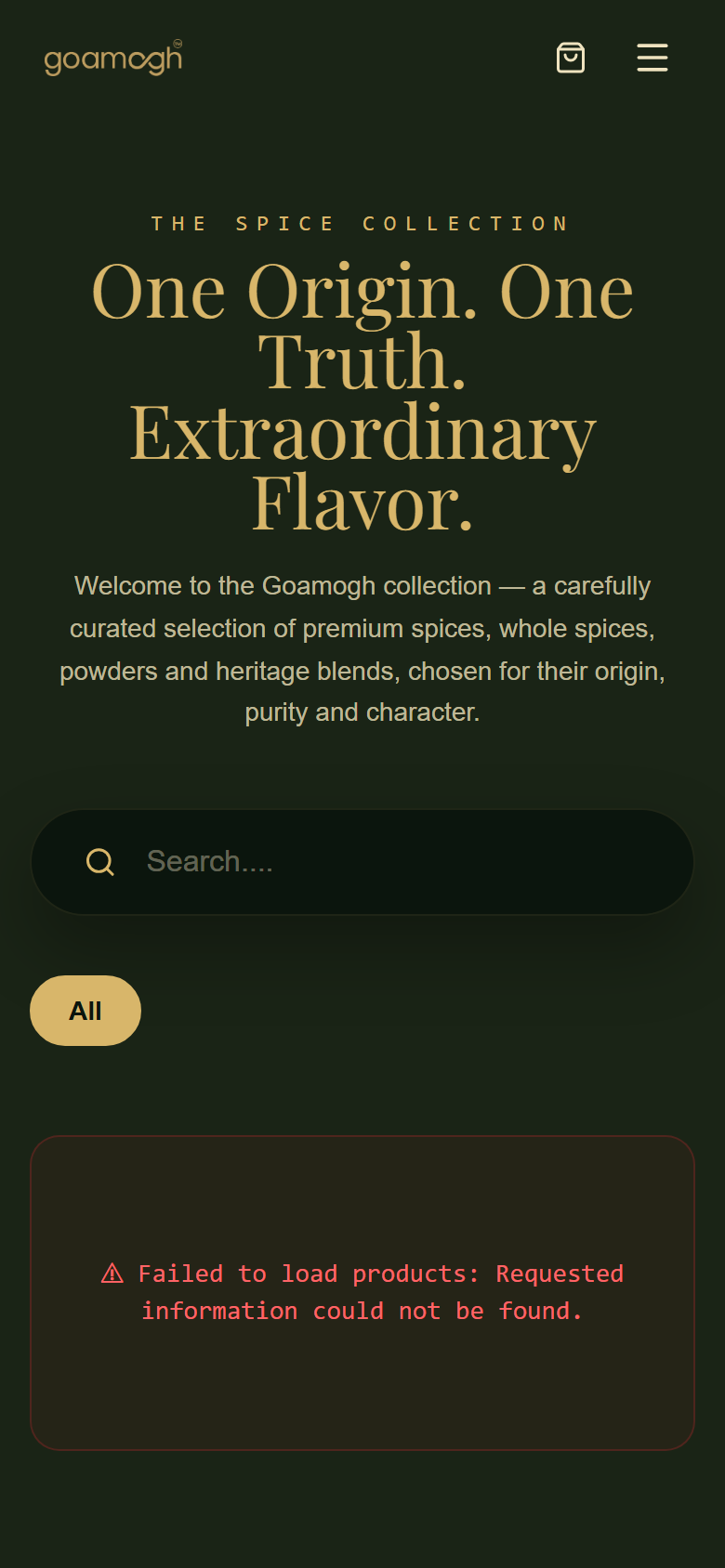
Every product request 404s. The shop renders a raw error message to the customer.
What the browser actually requested
200 /_next/static/chunks/…/app/shop/page-4d44009863d99600.js
…all static assets 200…
404 /undefined/api/v1/inventory/categories?active_only=true
404 /undefined/api/v1/inventory/items?is_sellable=true&active_only=true
console:
error: Failed to load resource: the server responded with a status of 404 ()
error: Failed to load resource: the server responded with a status of 404 ()
rendered to page:
"⚠ Failed to load products: Requested information could not be found."
The undefined/ segment is the literal API base. Note the endpoint paths —
/inventory/categories and /inventory/items?is_sellable=true — which tells
you the backend is an inventory service, almost certainly FastAPI, given the Pydantic
detail error shape and the 409/422 handling in the client.
The line in the bundle
let o = n(257).env.NEXT_PUBLIC_API_URL;
let a = "".concat(o, "/api/v1");
// o === undefined → a === "undefined/api/v1"
// same pattern for Razorpay:
let l = e || z.env.NEXT_PUBLIC_RAZORPAY_KEY_ID;
if (!l || l.includes("YOUR_KEY_ID") …) throw Error("Razorpay Key ID is not configured")
What is not broken
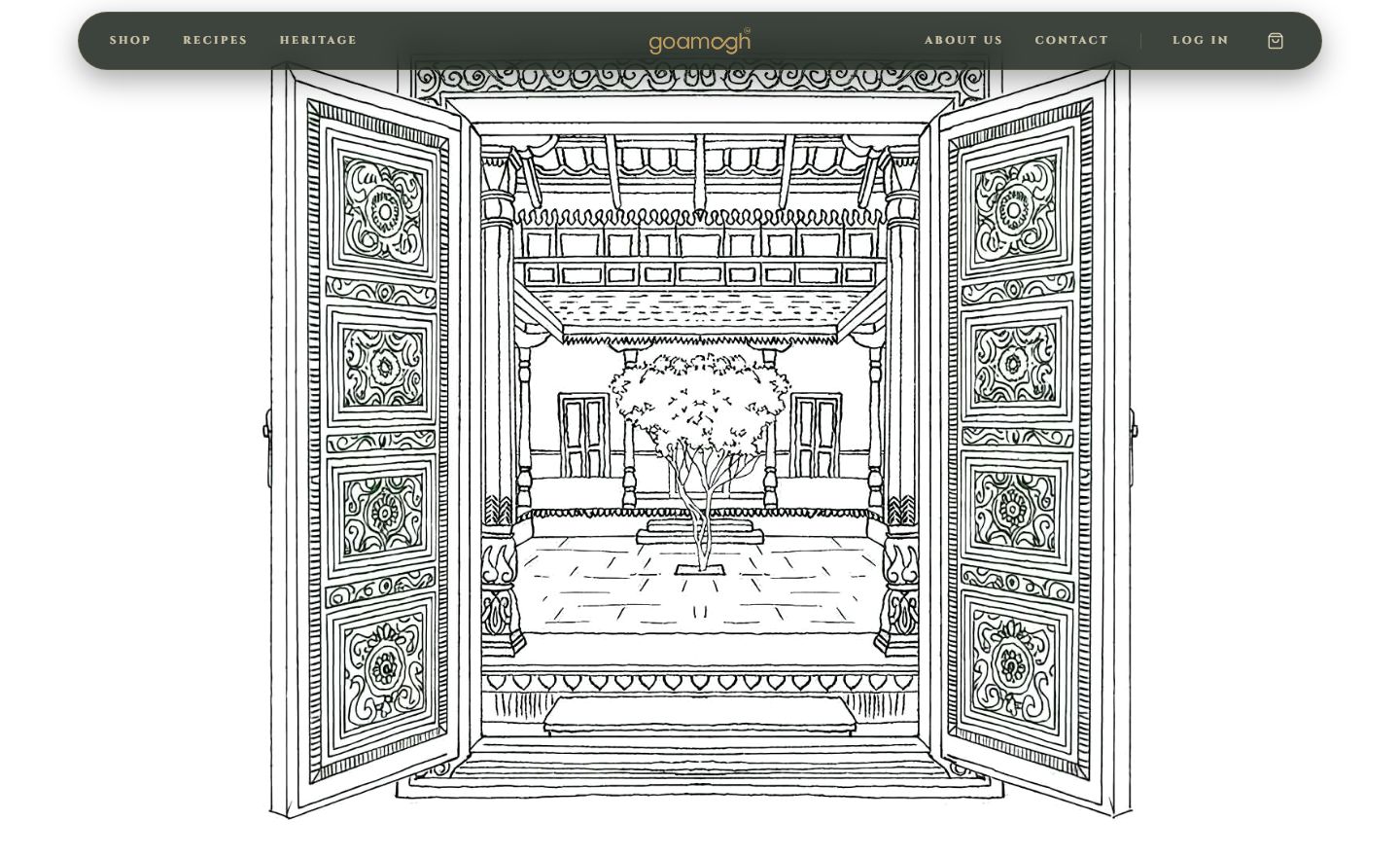
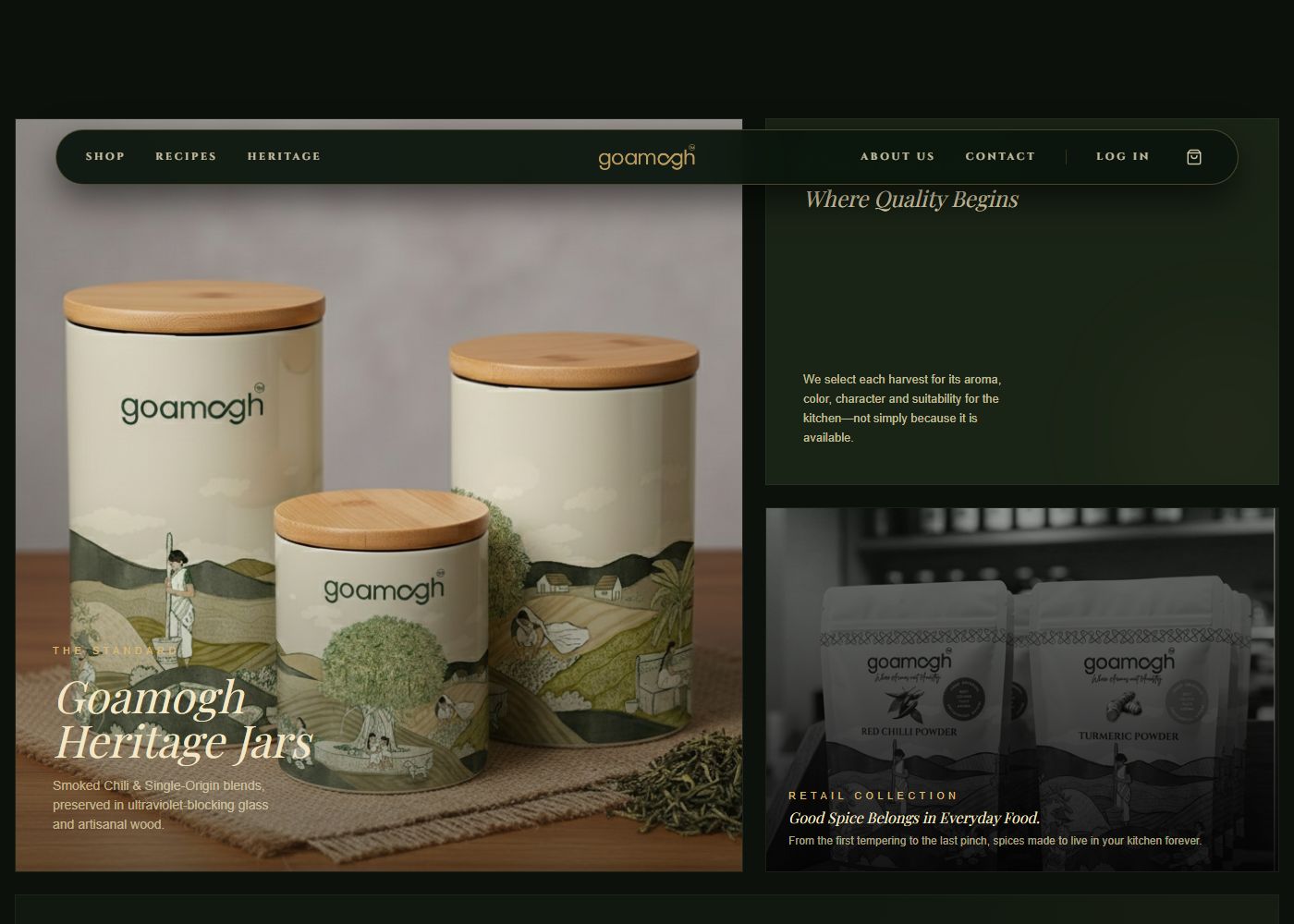
Worth saying out loud on Monday, because it reframes the problem as a two-hour config fix rather than a rebuild. The marketing pages render beautifully:
A correction I owe you
I previously flagged that your CoA was publishing Total Ash 0% and
Volatile Oil 0% as placeholder data, and called it a regulatory exposure. That
was wrong. The values are correct in the browser:
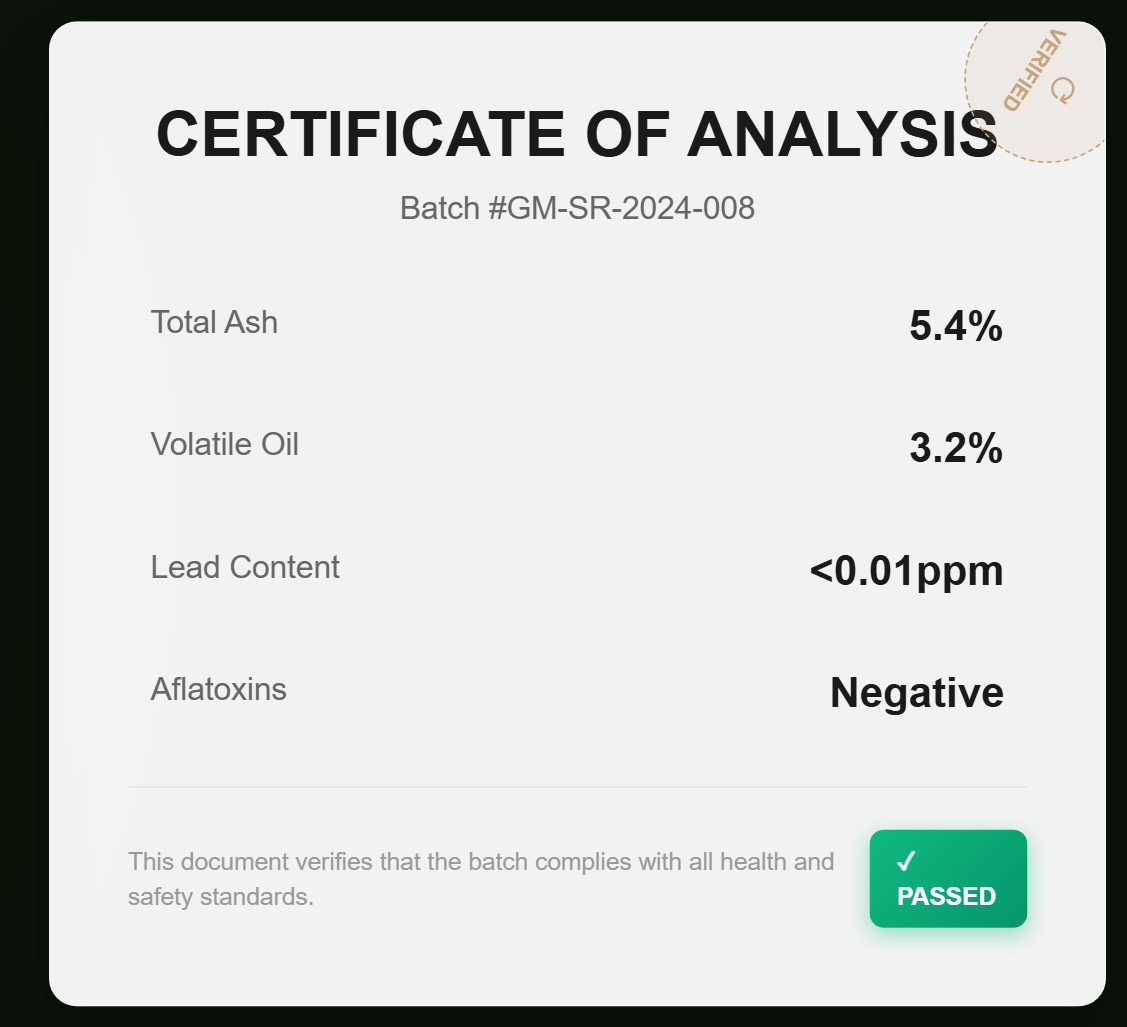
The 0% I saw was in the server-rendered HTML — the values are
injected client-side. So the real issue is smaller: Google, WhatsApp link previews and any
scraper see 0%, while customers in a browser see the correct numbers. That
is why my earlier search-result snippet showed 0%. Low severity, cosmetic — fix by
injecting the values server-side. Please disregard the food-safety warning in the earlier
draft.
One genuine loose end remains: the batch reads
GM-SR-2024-008 while the About page states EST. 2025. If that batch
predates incorporation it should be renumbered; if the year is a typo, correct it. An export QA
reviewer will notice.
Every rupee on ads, creators, marketplace listings or inventory would be spent driving customers
to this screen. Approve the Phase 0 fix first. Do not release media budget until
the shop is verified transacting end to end. Full repro, fix, 10-point acceptance test and a CI
guard: engineering ticket GM-ENG-001.
What to approve Monday
Three phases. Only the first two are being asked for today. Phase 2 is deliberately left open — you shouldn't commit to scale without 90 days of your own conversion data.
| Phase | When | Cost | Contains | Recommendation |
|---|---|---|---|---|
| 0 — Unblock | Weeks 1–4 | ₹1.8L one-time + ₹40K/mo | Fix storefront, analytics, indexable product pages, photography, ₹999 bundle, list on Amazon + Flipkart | Approve now, unconditional |
| 1 — Prove | Months 2–4 | ₹4.4L/mo | Meta + Google ads, creator seeding, organic content production | Gated on Phase 0 verified |
| 2 — Scale | Month 5+ | ₹6.5L/mo | Subscription, Performance Max, YouTube ads, export samples | Revisit after 90 days of data |
₹1.8L + ₹4.4L/month — the full Phase 0 + Phase 1. That is the ask.
Where Phase 1's ₹4.4L/month goes
| Line | ₹/mo | Why this is the priority |
|---|---|---|
| Creators (20 nano + 5 micro) | 1,50,000 | Best ROI in the plan: 6–8:1. Food & cooking is India's #2 engagement niche. ₹10–13 per engaged follower |
| Google Search (brand + high-intent) | 48,000 | ₹12–22 CPC but converts 2–3× better than Meta. Captures demand that already exists |
| Meta (Reels-first, manual) | 40,000 | Cold ROAS realistically 1.4–2.0× — plan for that, not the 4× in pitch decks |
| Marketplace content + photography | 60,000 | Front-loaded; drops to ~₹20K once the catalogue is built |
| Organic video production | 50,000 | "The Stone" / "The Batch" — a 2-year asset library from one shoot |
| Analytics + CRM tooling | 15,000 | WhatsApp flows, email, review capture |
| Creative testing reserve | 60,000 | The most valuable thing you will buy this year |
| Amazon Ads | 15,000 | ₹5K of this is covered by Amazon's free ₹26K seller incentive |
Ten numbers to carry into the meeting
The charts
The four arguments that decide this budget, visualised. If a decision-maker remembers one slide, make it the first.
Contribution per acquired customer. Gross margin assumed at 62%; blended Meta F&B CAC benchmark ₹250; Amazon platform take at the post-March-2026 zero-referral rate.
Line items: ₹349 → ₹216 gross margin − ₹18 platform − ₹40 fulfilment − ₹250 CAC. ₹999 → ₹619 gross margin − ₹30 platform − ₹60 fulfilment − ₹250 CAC.
Share of MRP retained by you after platform commission, closing fees, mandatory ad spend and trade promotions.
Quick commerce takes 10–13× more than a marketplace, and in exchange you hand over inventory ownership, price control and the customer relationship. Blinkit's own adjusted EBITDA is ~₹1 per order — there is no room for it to pay you more.
Campaign-level return on influencer spend by creator tier. Food & cooking is India's #2 engagement niche (micro creators 7.2% ER).
Cost per engaged follower: nano ₹12.9, micro ₹10.4, mid ₹6.0. Food creators charge at or below the general-lifestyle base rate, while finance and tech creators charge 30–50% more. 71% of Indian D2C brands now prefer micro over macro.
Inventory lost to expiry, as a share of inventory value. Premium D2C spice brands are effectively private label: when your Garam Masala nears expiry it is your loss, not a distributor's.
Closing the gap from 4.8% to 2.0% is worth ~2.8 points of margin ≈ ₹8.4L/year at ₹3 Cr revenue. A Google Sheet with three calendar triggers and a production cap does most of it. Ask your 3PL whether they already enforce FEFO and block dispatches below 30% shelf life.
The six channels, briefly
| Channel | Verdict | One-line reason |
|---|---|---|
| Build now | You have nothing, and food & cooking is India's #2 engagement niche | |
| Google Ads | Start small | Highest intent, converts 2–3× better than Meta. No PMax until 500+ conversions |
| Meta Ads | Reels-first | Cheapest CPMs, 3× reach. No Advantage+ until pixel matures |
| YouTube | Organic now, paid month 4 | Needs a content library first. ₹1.5L/mo minimum when you do |
| Amazon / Flipkart | Priority one | 0% referral fee under ₹1,000. Lowest CPC of any Amazon category at ₹9 |
| Quick commerce | Defer to month 12+ | 35–50% take, they own your inventory. Enter later as a ₹149 QR-code acquisition channel |
| Export | Start paperwork | Highest margin per unit. Central Licence + IEC now, first shipment in ~6 months |
You have nothing. This is your biggest gap.
Claim @goamogh today — unclaimed handles are free brand protection. Verify
goamogh.spices and goamogh_official as defensive registrations.
Post 30 days organic before spending anything on ads
- "The Grind" (2×/week) — process, raw audio, hands, the crackle. Your differentiation, free to film.
- "The Moment" (3×/week) — the tempering, the finished dish. Your 12 recipes are a ready-made engine.
- "The Proof" (1×/week) — batch number, lab numbers, origin. This is what justifies ₹8/100g over a kirana.
Creators are your paid Instagram — and they beat Meta ads
- ₹1.5–2.5L/month → 20 nano + 5 micro. Expected blended ROI 6–8:1.
- Regional creators outperform national in this niche — and you have an underexploited advantage in Andhra Pradesh.
- Insist on raw footage; negotiate usage rights +20–40%. You'll need both to run their content as paid ads later.
- Skip exclusivity (+30–50%) — the category is too small to justify it.
Google Ads
Capture existing intent. Deliberately small.
It needs 500+ monthly conversions and ₹3L+/month. Below 100 conversions it underperforms manual by 20–40%. Google's own learning period is 6 weeks — launching now means paying to exit learning.
- Start with brand terms + 15–20 high-intent non-brand terms only. ₹48K/month.
- Search CPC for food is ₹12–22, but Google traffic converts 2–3× better than Meta — comparable or better cost-per-acquisition for considered purchases. Premium spice buying is considered.
- Budget a half-day to pull Google Keyword Planner yourself. No public source exists for CPCs on spice keywords in India.
- Bid inflation is real: Search CPC rising 12–18%/year. Lock in your highest-intent terms early.
Meta Ads
Reels-first, manual, no Advantage+ yet
- Reels CPMs 15–25% cheaper than feed; Reels get 3× the reach of static at the same cost. For a sensory product this is the correct placement.
- Advantage+ needs 50+ purchases/week. Launching early means the algorithm learns on almost no data.
- Build the retargeting ladder before scaling. 3.5–5× ROAS warm vs 1.4–2.0× cold is where your profit lives.
- Budget for 25–40% COD return-to-origin — normal in India. Model on delivered revenue or your ROAS is fiction.
- Meta's reported ROAS typically under-states by 30–60%. Judge on your own analytics.
Creative rules that materially change results
- Hindi and regional-language versions lift CTR 30–70%; regional versions run 25–40% cheaper CPA in-state. Produce Telugu, Tamil, Malayalam, Hindi variants.
- 85% of Shorts plays are muted — burn in captions.
- Hook in the first 1.5 seconds: the crackle, the pour, the colour blooming in oil.
YouTube
Organic now. Paid much later.
Long-form food content ranks in search, gets recommended for years, and one shoot yields ~12 assets across every channel:
- "The Stone" — origin documentary, monthly
- "The Batch" — lab testing and what volatile oil % means, bi-weekly
- "The 60-Second" — one technique, one spice, one dish. Shorts, 3×/week
View-through conversions are 35–55% of YouTube revenue on 30-day windows. If you judge YouTube on clicks you'll kill a channel that's working.
- Skip paid YouTube until Month 4, and only with ₹1.5L+/month committed.
- Skippable in-stream CPV runs ₹0.30–1.00. Bumpers and non-skippables are brand-only in 2026.
Marketplaces & quick commerce
Amazon first. Flipkart second. Quick commerce last.
Amazon — priority one
- Claim the ₹36,000 new-seller incentive pack. ₹26K is ad credits — roughly two months of starter budget, free. New sellers only.
- Grocery & Gourmet has the lowest Sponsored Products CPC of any Amazon category at ₹9 median (₹4–16). Target ACoS 15–22%; breakeven 25–30%.
- Start on Easy Ship, not FBA. Spices are heavy and glass is expensive to store. FBA on a low-density, high-weight, slow-velocity product is usually a loss at your volume.
- Audit your range: whole nutmeg cannot be listed on Amazon at all — Grocery Negative List.
1. Dynamic bidding and placement adjustments can move a ₹10 bid to ₹200 — set bidding rules deliberately.
2. Closing fees rise 7 Sept 2026 (+₹1 under ₹500, +₹3 above). Reprice into the ₹999 band after that date.
Quick commerce — defer, and here's the honest reason
Blinkit, Zepto and Instamart run purchase-order / wholesale models. They don't sell your inventory for a commission — they buy your stock at 15–25% below MRP and own it. Real take after ads and promos: 35–50% of MRP. Stated brand viability line is 60–65% gross margin; below 55–60%, brands "consistently struggle."
- Blinkit's own adjusted EBITDA is ~₹1 per order. No room to pay you more.
- Redseer (Mar 2026): q-commerce "further skews towards everyday, high-velocity segment… which limited contribution from discretionary or niche categories."
- ZOFF built ~65% of revenue on quick commerce at ₹30–345 price points, not ₹999 glass jars. Not a benchmark you can copy.
- Gate on COGS below 35% of MRP. Below that it doesn't work at any price.
- One platform, not three. Zepto — fastest-growing, lowest take at 12–15%.
- Enter with a purpose-built ₹149–199 low-COGS sachet, not your ₹999 jar. The sachet is a customer-acquisition cost, not a revenue line.
- Print a QR code to goamogh.com on every sachet.
Export
Highest margin, longest cycle. Start the paperwork now.
- FSSAI Central Licence — mandatory for exporters regardless of turnover (₹7,500/yr). The new ₹1.5 Cr relaxation does not apply to you. Plus IEC and AD Code.
- Spices Board CRES is mandatory — and it has a trap: you commit to a 3-year block period, and if you don't export during it, renewal is refused. Don't apply speculatively.
| Priority | Market | Why |
|---|---|---|
| 1 | UAE / GCC | Diaspora density, distance advantage from AP, low tariff friction, English-speaking. Also an Amazon AE on-ramp. Most realistic first market |
| 2 | UK | Large diaspora, established "premium Indian" shelf, easy third-party certification |
| 3 | USA | Highest margin, highest compliance burden. Enter via Amazon Global Selling before direct retail |
| 4 | Singapore / Australia | Small, well-regulated, low-friction |
- GST is 5% on HSN 0910, 09109100 and 09109990 (mixtures of spices). Confirm classification with your CA.
- Premium tiers command 4–8× commodity prices while production cost rises only 1.5–2×.
- Timing reality: export is 6–12 months, not a quarter. First goal is one repeat buyer, not a distribution network.
The AI section
Your AI budget for six months is ₹15,000–30,000 per month, and most of the value is in things that cost nothing. Most AI tooling pitched at your scale is unnecessary, wrong-shaped, or actively risky for a premium food brand.
Expiry and FEFO management is worth ~2.8 points of margin — roughly ₹8.4 lakh a year at ₹3 Cr revenue — and it costs nothing. See the fourth chart above.
Why it bites: FSSAI requires 30% shelf life remaining on delivery, and dark stores typically reject at 50–70%. For a 180-day product with a 60% inbound rule you can only sell for ~54 days. FEFO vs FIFO is documented at 0.5–1.2% write-offs vs 3–5%.
2.8 points of margin ≈ ₹8.4L/yr. More than everything else here combined
heat_level, primary_dish, occasion. Fixes "something warm for dal" without buying AIFlat, unlimited, no order cap. Unbeatable at this volume
7–15× cheaper than Meta's own agent in India
AI bundles, frequently-bought-together. Best AOV-per-rupee in personalisation
Review mining. Paste CSV into any LLM for the analysis
HS code lookup. Cross-check only — not a substitute for a consultant
Backgrounds, image expansion to 9:16, text variations. No cap. Preview every variant before publishing
6 fifteen-second ads from an ASIN. Amazon's data: +10.3% ROAS on Sponsored Brands, and 60%+ of products it advertises were never advertised before
Inside the ad product. AI Max is now the default for broad-match from Sept 2026
~50 fast 8-second clips/month. Enough for your entire Reels/Shorts output
4–5 of 7 images must be shot. Amazon requires a real photo on pure white for image 1. AI shifts the fill level and spice colour in a transparent jar — misrepresentation, not taste
Clearest hype item. Needs 12–18 months of history you won't have for 2 years. At 15 SKUs a Google Sheet is more accurate because n is tiny. Custom builds cost ₹8–20 lakh
7–15× more expensive in India. Use a cheap BSP with your own LLM
₹2.7L–₹26L/year. Built for $50M+ GMV retailers
Wrong problem. At 15 SKUs a quiz narrows 15 items to 3. Judge on list growth, not quiz conversion. A/B testing locked to the ₹17,800 Plus tier
FTC fake-reviews rule (16 CFR Part 465), civil penalties. Destroys the trust asset you're paying Judge.me to build
Use IMERO or Copago as a service. Platform licences are for 100+ SKUs
Two AI risks specific to a premium food brand
Amazon's July 2026 contains-synthetic-performer requirement is worldwide,
carries $1,000 / $5,000 penalty exposure under New York's Fashion Workers Act, and
creates a visible credibility gap against brands who shot real models. Product-only AI imagery does
not trigger the rule — so keep humans out of it entirely.
Origin shots and lab-certificate imagery must stay real photographs. Regulated food-safety claims are exactly where generative imagery should not go.
The quiz question, honestly
If someone proposes a flavour quiz, the real prize isn't conversion — it's email opt-in (42% vendor-claimed, corroborated by an 80%-of-list figure at a beauty brand). Judge on list growth and 90-day repeat, not quiz-completion conversion.
Be sceptical of Indian food case studies: Kaatil, Millet Amma, Dhampur Green, Tea Culture, SuperYou and Aakash Namkeen are all from one vendor, unaudited, using their own attribution model. The closest true analogue, Mothers Foods (a Kerala masala brand), published no numbers at all.
Two time-sensitive items
Service messages are now ₹0.115 each after 1,000 free per phone number/month. At 6,000 orders × ~3 support messages, your bill is ~₹2,300/month.
Non-event. Don't let anyone present this as a crisis in the meeting.
+₹1 on products under ₹500, +₹3 above. Reprice into the ₹999 band after that date.
Expected pushback, with the answers
| Likely challenge | Response |
|---|---|
| "Competitor cases show +25% AOV and +30% sales from AI personalisation" | All one vendor (Anphonic/Rebuy), unaudited, own attribution model. The closest true analogue — Mothers Foods, a Kerala masala brand — published no numbers at all |
| "Let's run Performance Max" | Underperforms manual by 20–40% below 100 monthly conversions. We'd be paying to exit a 6-week learning phase |
| "We should be on Blinkit/Zepto like ZOFF" | ZOFF sells at ₹30–345 and is ₹100 Cr+ with ~247 staff. At ₹999 in glass you'd earn the same contribution and hand over inventory and the customer |
| "AI will cut photography costs 80%" | A studio competing against AI puts the honest figure at 45–55%, not 80% — and that's for replacing all photography. Our hybrid saves 25–40% |
| "Amazon first, quick commerce second" | Right sequence — but quick commerce isn't phase 2, it's month 12+, and only if COGS is under 35% of MRP |
| "Let's buy a WhatsApp chatbot from Meta" | Meta's own agent is 7–15× more expensive in India. Same function, ₹999/month instead of per-message |
| "Why no YouTube ads in the budget?" | ₹1.5L+/month minimum plus a content library first. Month 4 at the earliest. Organic YouTube sits in the ₹50K production line |
| "The CoA shows 0% — that's a food-safety problem" | It does not. The hydrated page shows 5.4% total ash and 3.2% volatile oil — both correct. Only server-rendered HTML and link previews show 0%. Cosmetic SEO issue, not regulatory. See section 01 |
| "The site looks fine when I open it" | The marketing pages do. The shop page renders a raw error and no product data exists in the served HTML. Open /shop in the meeting — screenshots are in section 01 |
First 30 days
Unblock
- Fix the storefront (
GM-ENG-001). Rebuild with the env vars set; confirm the literal API URL appears in the bundle - Inject CoA values server-side so Google and link previews stop seeing
0%; fix the 2024 batch date - Claim
@goamogh+ defensive handles; add social links to the footer - File trademark (Class 30) — unblocks Amazon Brand Registry
- Install GA4 + GTM + Meta Pixel + Conversions API + Merchant Center + Search Console
Make it sellable and indexable
- Server-render every product page with a real crawlable URL; Product/Offer schema; product URLs in
sitemap.xml - Shoot 7 images per SKU — 4–5 real, AI for the lifestyle scene only
- Build the ₹999 "Flight" bundle and the ₹149 entry SKU. Reprice the catalogue
- Add quarterly subscription (₹1,499)
- Set up WhatsApp flows for abandoned cart, order status and reorder
- Verify your FSSAI scope explicitly names spice mixes — the #1 cause of Grocery category rejection
Open the demand channels
- Amazon Seller Central: register, claim ₹36,000 incentive, Brand Registry, list top 10 SKUs
- Flipkart in parallel
- Switch on the free AI creative tools (Meta Advantage+, Amazon Creative Studio)
Launch and learn
- Meta Reels ads — 5 creatives, manual, broad. ₹40K/mo
- Google Search — brand + 15 high-intent non-brand terms. ₹48K/mo
- Seed 20 creators; start posting 4×/week
- Ask your 3PL today whether they enforce FEFO and block dispatches below 30% shelf life. It may already be solved, and it's worth ₹8.4L/year
Data caveats, stated plainly
Your actual SKU list, MRP and COGS could not be retrieved — the shop is behind the broken API. Every pricing recommendation here assumes your stated ₹150–600 band.
Re-verify the moment the shop loads. If real COGS is above 35% of MRP, quick commerce is permanently off the table regardless of strategy.
The USD→INR rate varied between research sources (₹89–₹96). All INR figures are conversions, not vendor-quoted India pricing. No major AI vendor publishes India-specific pricing or GST-inclusive billing.
The document often referred to as "the FSSAI 17/4 letter" doesn't exist under that name. Section 17(4) of the FSS Act concerns authenticating Food Authority orders. If someone told you to obtain it, ask what document they actually meant.